Madmaheshwar Trek Difficulty: Is It Hard?
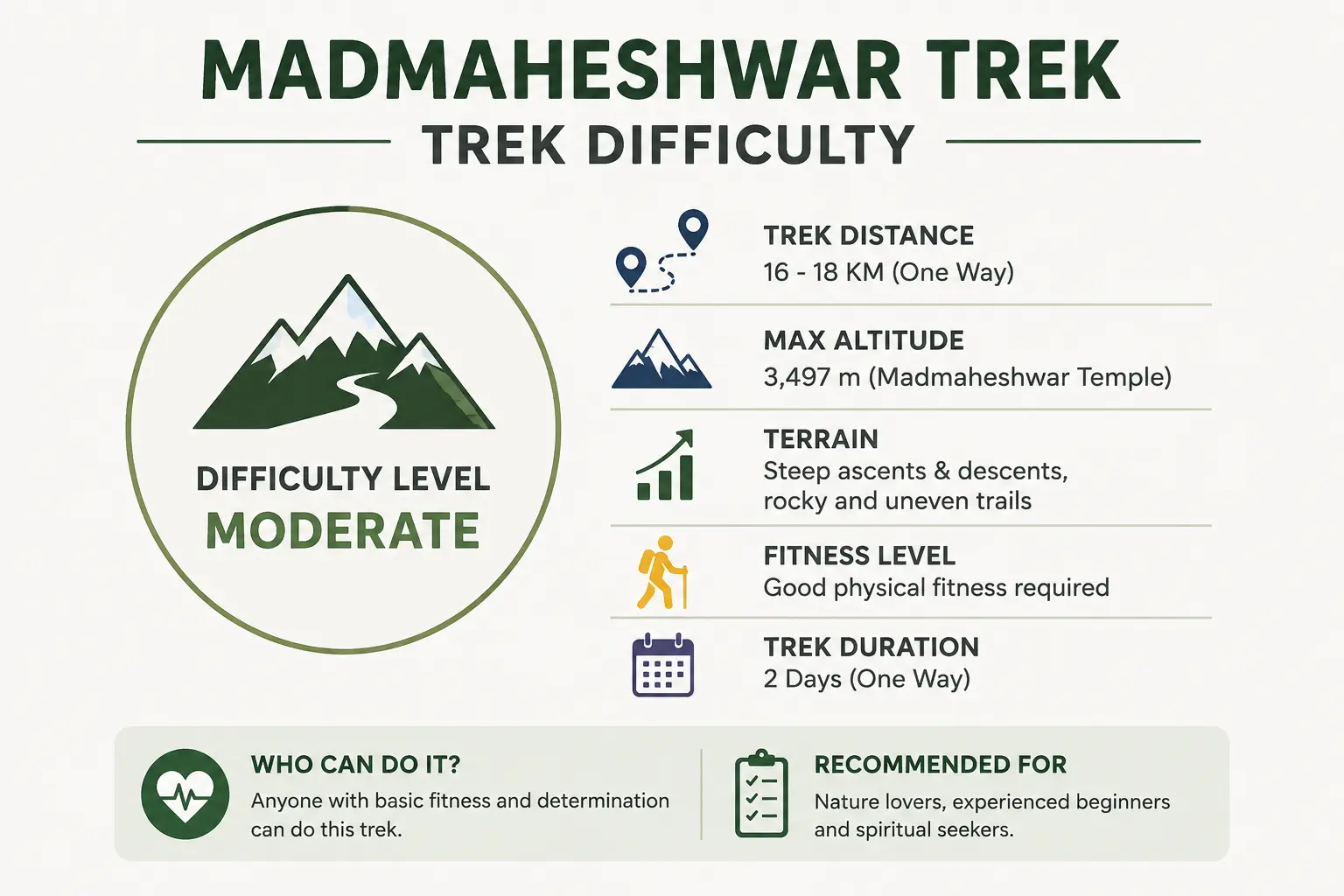
The Madmaheshwar Trek difficulty is best described as moderate to demanding for most recreational trekkers.
It is not a technical mountaineering route, and you do not need climbing skills or specialized mountaineering equipment to reach the main Madhyamaheshwar Temple during normal trekking conditions.
What makes the trek challenging is something different: sustained uphill walking, accumulated fatigue, uneven Himalayan terrain, and the need to keep climbing after the easier opening section is behind you.
Official Uttarakhand Tourism itself describes the journey to Madhyamaheshwar as a tedious and arduous hike, which reflects the physical effort involved even though the route is primarily a trekking trail rather than a technical climb. Official Uttarakhand Tourism information on Madhyamaheshwar also identifies the area as a high-altitude trekking destination.
For a reasonably fit person who prepares properly and walks at a controlled pace, the trek is achievable.
For someone who is sedentary, unprepared for continuous climbing, or carrying excessive weight, the same trail can feel significantly harder.
Madmaheshwar Trek Difficulty Rating
Our practical editorial assessment is:
Difficulty Factor | Rating |
|---|---|
Technical climbing | 1/5 |
Walking endurance | 4/5 |
Sustained uphill effort | 4/5 |
Uneven terrain | 3/5 |
Altitude effect | 3/5 |
Downhill strain | 3/5 |
Overall difficulty | Moderate to Demanding |
Important: This is an editorial planning assessment, not an official government grading system.
The trek does not become difficult because of one single obstacle. Its challenge comes from several moderate demands adding up over many hours.
What Makes the Madmaheshwar Trek Difficult?
Four factors matter more than anything else.
1. Sustained Climbing
The most important difficulty factor is prolonged uphill walking.
Short steep sections are manageable for most people.
The challenge is repeating that effort for hours while continuing to gain elevation.
Someone with strong general fitness but little experience walking uphill may find the climb surprisingly tiring.
2. Accumulated Fatigue
The first few hours do not always reveal how difficult the complete trekking day will feel.
Fatigue builds gradually.
Legs become heavier, breathing becomes more noticeable, and even moderate slopes can begin to feel steep later in the day.
This is why pacing matters more than speed.
3. Uneven Himalayan Terrain
The trail is not equivalent to walking the same number of kilometers on a road or treadmill.
Stone paths, irregular steps, wet patches, forest trails, and changing gradients require more concentration and muscular effort.
Your ankles, knees, calves, and stabilizing muscles work continuously.
4. Elevation
As the trek progresses toward the higher sections, some travelers may notice that they become breathless more quickly than they would at lower elevations.
That does not automatically mean something is wrong, but it is one reason aggressive pacing is a poor strategy.
The goal should be steady forward movement, not trying to maintain your normal city walking speed.
What Is the Hardest Part of the Madmaheshwar Trek?
For many trekkers, the most demanding phase begins after the easier lower-valley portion of the trek.
The route becomes more consistently uphill, and the combination of gradient and accumulated fatigue starts to matter much more.
This is also what your existing Madhyamaheshwar content consistently identifies as the point where the trek changes from relatively manageable walking to a much more demanding climb. (Madhyamaheswar)
This page intentionally does not repeat the full village-by-village sequence.
If you want the exact trail progression and waypoints, use the Madmaheshwar Trek Route guide.
Is Madmaheshwar Trek Difficult for Beginners?
A fit beginner can complete the Madmaheshwar Trek.
But “beginner-friendly” should not be interpreted as “easy.”
A first-time Himalayan trekker is in a reasonable position to attempt it if they:
Walk or exercise regularly
Can handle several hours of activity
Are comfortable climbing stairs or hills
Do not expect to rush
Are willing to take controlled breaks
Keep their backpack reasonably light
Have no unmanaged health condition that makes strenuous walking unsafe
A completely sedentary traveler should not rely on determination alone.
This trek rewards preparation much more than speed.
If this will be your first serious mountain trek, follow the separate 30-Day Madmaheshwar Trek Fitness Plan rather than trying to turn this difficulty page into another training guide.
A Simple Readiness Check Before the Trek
You do not need to be an athlete.
But before traveling, ask yourself these questions:
Can I walk continuously for several hours without becoming exhausted?
Can I climb stairs or an incline without needing to stop every few minutes?
Can I repeat a similar effort the following day?
Can I walk downhill without significant knee or ankle problems?
Can I maintain a slow pace without feeling pressured to follow faster trekkers?
If most answers are yes, the trek is likely within a realistic range for you under normal conditions.
If basic walking already feels physically demanding, prepare first.
This self-check is a practical planning tool, not a medical fitness test.
Is the Madmaheshwar Trek Technically Difficult?
No.
The normal pilgrimage trail does not require technical rock climbing, ropes, crampons, or mountaineering skills during ordinary trekking-season conditions.
That distinction is important.
A trek can be physically demanding without being technically difficult.
Madmaheshwar is primarily an endurance and uphill-walking challenge, not a climbing expedition.
This is why a well-prepared beginner may perform better than an experienced traveler who arrives untrained and tries to move too quickly.
Why Downhill Can Also Feel Difficult
Many people think reaching the temple is the hard part and returning will be easy.
That is not always true.
Long downhill walking repeatedly loads the:
Knees
Quadriceps
Ankles
Calves
Toes
If your legs are already tired from the ascent, the descent can become uncomfortable.
Controlled steps are more important than speed.
Travelers with a history of knee or ankle problems should consider their own condition carefully before undertaking a long mountain descent.
Does Weather Change the Difficulty Level?
Yes—significantly.
A trail that feels manageable when dry can become much more demanding when rain makes stone, soil, and vegetation slippery.
Poor visibility can also slow walking and increase the concentration required on uneven terrain.
Your dedicated Madmaheshwar Trek in July and Monsoon Guide covers seasonal hazards separately, so they are not duplicated here.
Before beginning the trek, travelers should also check current India Meteorological Department weather forecasts and warnings.
Difficulty ratings are meaningful only when considered alongside actual conditions on the day.
Is Madmaheshwar Trek Harder Because of Its Distance?
Distance contributes to fatigue, but kilometers alone do not explain the difficulty.
A flat 15-kilometer walk and a Himalayan 15-kilometer trek can feel completely different.
Gradient, surface, elevation gain, weather, backpack weight, and accumulated fatigue determine how demanding the day becomes.
For that reason, this page does not repeat kilometer calculations.
If your question is specifically about one-way, round-trip, or differing published distance figures, read the Madmaheshwar Trek Distance guide.
Who May Find the Trek More Difficult?
The trek can feel significantly harder for travelers who:
Do little regular physical activity
Carry an unnecessarily heavy backpack
Start too quickly
Sleep poorly before trekking
Ignore hydration
Have weak downhill tolerance
Try to match faster group members
Leave insufficient recovery time
Trek in difficult weather
Most of these factors are controllable.
The mountain cannot be made flatter, but your preparation and pacing can make the experience much more manageable.
Who Should Reconsider Attempting It Without Preparation?
Extra caution is appropriate if you have:
Significant heart or respiratory conditions
Uncontrolled blood pressure
Recent major surgery or injury
Serious knee or ankle problems
Very low exercise tolerance
A medical condition affected by sustained physical exertion
This does not automatically mean you cannot visit Madhyamaheshwar.
It means an individualized medical assessment may be appropriate before committing to a demanding mountain trek.
Families evaluating the route for different age groups should use the dedicated Madmaheshwar Trek for Families, Kids and Senior Citizens rather than applying a single difficulty rating to everyone.
How to Make the Trek Feel Easier
You cannot remove the uphill sections, but you can reduce unnecessary difficulty.
Walk Slower Than You Think You Need To
A controlled pace early in the day preserves energy for later climbing.
Keep Your Backpack Light
Every unnecessary kilogram becomes more noticeable after several hours uphill.
Take Short, Useful Breaks
Frequent very long stops can make restarting uncomfortable.
Rest enough to recover, then continue steadily.
Eat and Drink Before You Feel Depleted
Do not wait until you are exhausted before taking care of basic energy needs.
Stop Competing With Other Trekkers
Someone else's pace tells you nothing about the pace that is safe or sustainable for you.
Many trekking problems begin when people treat a pilgrimage trail like a race.
For other avoidable issues that make the journey unnecessarily harder, see Common Mistakes on the Madmaheshwar Trek.
Madmaheshwar Trek Difficulty FAQs
How difficult is the Madmaheshwar Trek?
The Madmaheshwar Trek is best considered moderate to demanding. It does not require technical climbing skills, but sustained uphill walking and accumulated fatigue require reasonable fitness.
Is Madmaheshwar Trek suitable for beginners?
Yes, a physically prepared beginner can attempt the trek under suitable weather and trail conditions. An untrained sedentary traveler may find it considerably harder.
Do I need mountaineering experience?
No. The normal Madhyamaheshwar pilgrimage route is a trekking trail rather than a technical mountaineering route.
What makes Madmaheshwar Trek difficult?
The primary challenges are sustained climbing, long hours of walking, uneven terrain, accumulated fatigue, elevation, and the strain of the return descent.
What is the hardest part of the trek?
For many travelers, the sustained uphill portion after the easier lower section is the most physically demanding because the gradient increases after fatigue has already begun accumulating.
Can an unfit person complete the trek?
It may be possible, but attempting it without basic preparation increases the chance of exhaustion, discomfort, and an unnecessarily difficult experience.
Is the return trek easier?
It requires less uphill effort but can still be demanding because long descents place repeated strain on the knees and legs.
Does rain make the trek harder?
Yes. Wet and slippery surfaces, reduced visibility, and changing mountain conditions can substantially increase the practical difficulty.
How fit should I be for Madmaheshwar Trek?
You do not need athletic-level fitness, but you should be comfortable with several hours of walking and sustained uphill effort before attempting the journey.
Final Verdict: How Hard Is Madmaheshwar Trek?
Technical difficulty: Low
Physical endurance: Moderate to High
Uphill effort: High
Overall rating: Moderate to Demanding
Madmaheshwar is not a trek that requires advanced climbing ability.
It is a trek that rewards patience, leg strength, walking endurance, and sensible pacing.
A prepared beginner can complete it.
An unprepared traveler can find it very difficult.
That distinction matters more than attaching a single universal grade to the mountain.
Approach the trek with realistic expectations, prepare your body beforehand, walk at your own pace, and allow the terrain—not other trekkers—to determine how quickly you move.